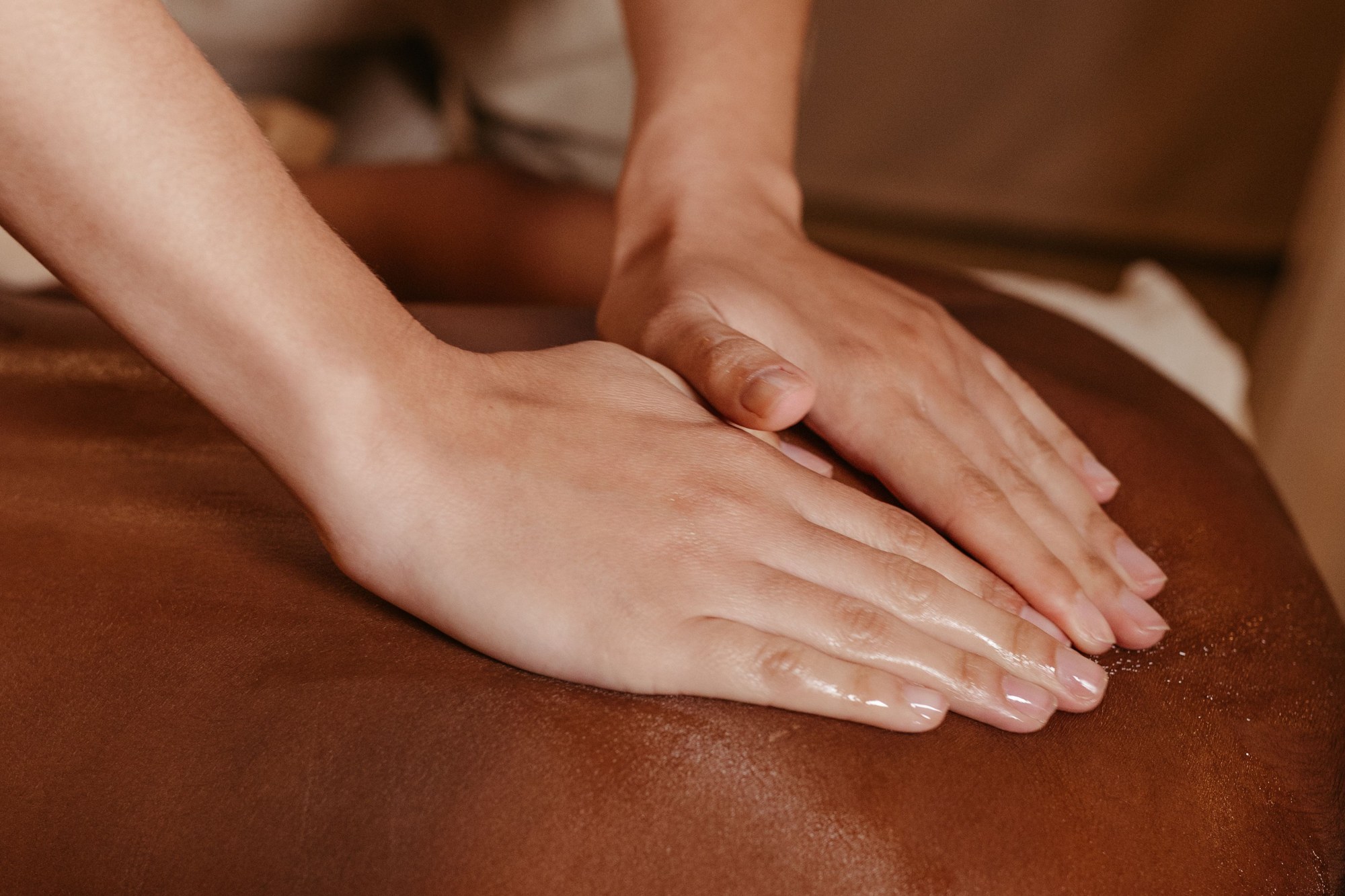
Individual variation is the reason why there’s not one true correct level of firmness for massage. It’s the same reason some people love spicy food, and some people want nothing to do with it. Some people find subtle, nurturing touch pain-relieving, some people need big sensations for effective massage to take place.
Where the idea that massage should hurt comes from
It has several sources, and most of them are understandable.
- Reputation. Some massage lineages are known for intensity, and stories about them get around.
- Gym culture. “No pain, no gain” followed people from the weight room onto the massage table.
- Relief that feels like proof. When something intense stops, the contrast feels wonderful. It’s easy to credit the pain for the relief.
- Our own vocabulary. Massage therapists talk about “good pain.” It’s reasonable for clients to hear that and conclude that pain is the goal.
Pain is also a biopsychosocial experience. How you feel it depends on your biology, your history with pain, and the culture you grew up in. Two people on the same table, under the same pressure, can have very different experiences.
What your therapist means by “on a scale of one to ten”
If you’ve been to an emergency room, you know a pain scale where 10 is the worst pain imaginable. The massage scale works differently. Ten is not the worst pain you can imagine.
On the massage scale, 1 is barely any sensation. Ten is the most intensity you’re willing or able to handle today. “Today” matters, because sleep, stress, hormones and yesterday’s workout all move that ceiling.
Many therapists who do focused, deep work aim for somewhere between 5 and 8, often around 7. That’s strong enough to register clearly but not so strong that your body starts fighting it. It’s a rule of thumb from training, not a number research has pinned down, and a good therapist treats your answer as information rather than a target to hit.
Intensity that works vs. pain your body fights
Your massage therapist may call this “good pain vs. bad pain.” What they mean by good pain is intensity your body isn’t fighting. In this post, we call that intensity, and save the word pain for the moment your body starts to fight back. The difference isn’t how strong the pressure is. It’s what your nervous system does with it.
Intensity that’s working: you can breathe into it. It eases or melts as your therapist stays there. It may be strong, but it feels satisfying.
Pain your body is fighting: your nervous system reads the pressure as danger and takes over. You’ll notice some of these signs:
- Muscles tighten or splint under the pressure instead of softening
- You hold your breath
- Tension shows up somewhere else: fists, curled toes, tight calves, a clenched jaw, a scrunched face
- The sensation is sharp, electric or radiating
- It gets worse instead of easing
Once that happens, you and your massage therapist are working against each other. It becomes a workout, not a massage. More pressure won’t get past guarding. It only makes your body hold on harder.
When you can’t trust the feeling
Many people don’t have a reliable sense of where that line falls. Some have lived with chronic pain for years. Some learned to dissociate to get through painful experiences. Some learned along the way that enduring is a virtue.
People like this can be remarkably good at tolerating pain, and less good at noticing when it has crossed into harm. They are often the same people asking for more pressure.
If that sounds familiar, you don’t have to rely on feeling alone. The signs above are physical: your breath, your jaw, your hands. You can check them, and your massage therapist can see them. If you notice you’ve stopped breathing, that’s your answer, whatever number you would have given.
The euphoria trap
A massage that was painful and difficult to endure can leave you feeling amazing as you walk out the door. You might feel floaty, lit up, almost high. That isn’t proof it worked. Often it’s a stress response: adrenaline and your body’s own painkillers, released because it registered something like an injury.
When that wears off, the bill comes due. There’s a real difference between being a little sore and being worse off.
Normal strong work may induce mild soreness, like after a good workout, that eases steadily within a day or two. You can move about the same, hopefully with more ease than before the massage.
Massage that has gone too far leaves you feeling hot, swollen, or bruised. If the work was too deep, pain may get worse before it gets better, or it will last for several days. The big giveaway that it’s too far is if your movements feel stiffer or more limited than before.
If you experience the too-far discomforts, tell your massage therapist. It’s information they need to adjust next time. Pain that’s severe, or numbness or tingling that doesn’t fade, is worth a call to your doctor.
How to steer your session
You can share your physical experience at any point. A good massage therapist wants you to. Three words cover most of it: more, less, stay there.
Your massage therapist can read a lot through your tissue, but not everything. Sometimes a spot is more tender than it feels under their hands, so tell them the moment it is.
A good therapist trusts you right away when you say it’s too much, with no debate. A good therapist might push back when you ask for more, because they can feel your tissue guarding.
That’s a deliberate double standard, and it’s the right one. “Too much” is always a complete answer. “More” is a request they weigh against what your body is telling them. You never need a reason to ask for lighter pressure.
So, should massage hurt?
It can be intense. It shouldn’t hurt.
At its best, massage isn’t about how much you can take. It gives your body a chance to pay closer attention to itself. Sensation turns up and down, and your nervous system gets a chance to settle somewhere new. Massage therapists who do this well are experts at guiding you through unfamiliar sensation, not at testing your limits.
If you like strong work, browse massage therapists who offer deep tissue, neuromuscular therapy and barefoot massage. If you’d rather keep it gentle, try Swedish, relaxation or lymphatic drainage.